
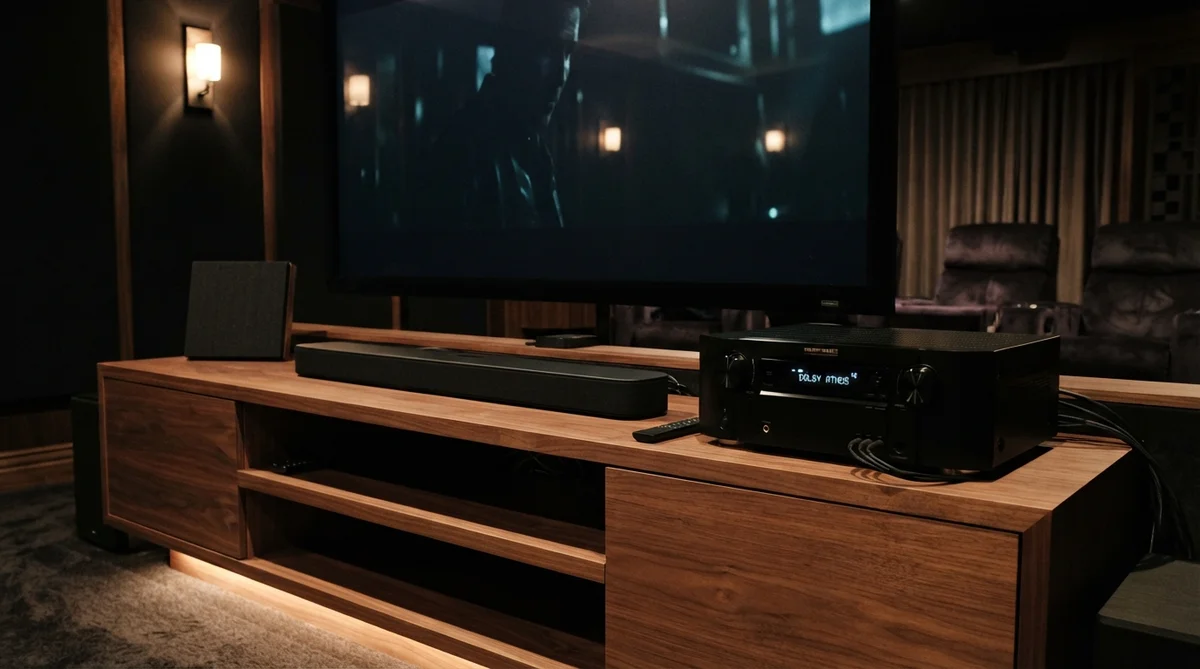
Soundbar vs. AV Receiver: At a Glance
Soundbars offer compact plug-and-play simplicity for casual TV viewing in small to medium spaces, whereas an AV receiver system delivers authentic multi-channel immersion, precise sound separation, and modular expandability for serious home cinema setups. Understanding the soundbar vs av receiver trade-offs helps you select an audio foundation that balances living room integration with acoustic performance.
| Factor | Soundbar System | AV Receiver System | Ideal Choice |
|---|---|---|---|
| Setup Complexity | Plug-and-play via HDMI eARC in 10 minutes | Requires manual speaker wiring and calibration | Soundbar for simplicity |
| Acoustic Performance | Virtualized surround with compact drivers | Discrete multi-channel audio with dedicated drivers | AV Receiver for power |
| Physical Footprint | Minimal space directly under TV screen | Requires receiver cabinet and surrounding speakers | Soundbar for small rooms |
| Upgradability | Self-contained with limited expansion options | Fully modular component and speaker replacement | AV Receiver for longevity |
The ultimate decision hinges on your room layout, total budget, and whether you are willing to trade setup effort for authentic spatial immersion.
Understanding Soundbars: Pros, Cons, and Best Use Cases
Understanding why you need a soundbar and where to put it starts with display technology. Ultra-thin modern televisions leave virtually no interior volume for capable acoustic drivers, forcing built-in speakers to direct audio downward or backward against living room walls. A soundbar restores frontal projection, placing high-frequency tweeters and mid-range drivers directly beneath your screen to clarify dialogue and center-channel effects.
Independent evaluations by Consumer Reports show that even entry-level soundbars significantly outperform built-in TV speakers in vocal intelligibility and soundstage width. Learning how to choose a soundbar involves checking for HDMI eARC connectivity, evaluating whether it includes a wireless subwoofer for low-frequency impact, and determining if virtualized Dolby Atmos processing fits your viewing habits.
- Key Advantages: Rapid setup using a single HDMI cable, low visual footprint, integrated amplification, and lower initial hardware cost.
- Main Drawbacks: Narrow physical soundstage, virtualized audio channels that depend on wall reflections, and zero component upgrade path.
- Best Use Case: Apartments, bedrooms, secondary viewing areas, or living rooms where running speaker wires across floorboards is impractical.
Understanding AV Receivers: Pros, Cons, and Best Use Cases
An Audio Video (AV) receiver serves as a central command unit that routes 4K and 8K video while amplifying individual passive speakers. By separating amplification from physical speaker enclosures, receiver systems deliver uncompressed power, massive dynamic range, and precise channel separation across discrete 5.1, 7.1, or 9.2.4 speaker configurations.
Acoustic research published by the Audio Engineering Society confirms that discrete physical speaker placement provides superior channel isolation compared to single-bar enclosures. Modern AV receivers feature automated microphone calibration systems, such as Audyssey MultEQ or Dirac Live, which measure room dimensions and correct frequency imbalances automatically.
- Key Advantages: Genuine spatial surround sound, high power output per channel, extensive HDMI input switching, and complete freedom to upgrade individual speakers over time.
- Main Drawbacks: Larger equipment footprint, higher total system cost, complex cable management, and a steeper learning curve for tuning.
- Best Use Case: Dedicated home theater rooms, large open-concept basements, and film enthusiasts who demand true cinematic impact.
Key Differences: Soundbar vs AV Receiver
Audio Quality and Spatial Sound
Evaluating the av receiver vs soundbar movie sound quality difference reveals clear acoustic distinctions. Soundbars use tightly grouped speaker arrays inside a single cabinet, relying on digital signal processing (DSP) and angled drivers to bounce sound off side walls. While premium soundbars produce impressive psychoacoustic tricks, they cannot replicate physical speakers positioned behind or above the listener.
An AV receiver supplies dedicated power channels to physically separate speakers located around the room. This separation creates realistic audio panning, precise vocal placement through a dedicated center channel, and deep, distortion-free low end powered by active subwoofers. Movies encoded in Dolby Atmos or DTS:X gain true height and depth when processed by a receiver powering actual overhead speakers.
Setup Complexity and Space Requirements
Setup complexity represents one of the largest operational divides between these two audio paths. A soundbar rests on a media console or mounts directly beneath the screen, requiring only a power cord and a single HDMI eARC connection to your television. Cable clutter remains minimal, making soundbars an attractive option for minimalistic interior designs.
In contrast, an AV receiver requires a dedicated shelf inside an entertainment cabinet due to its physical dimensions and heat ventilation needs. Installing a 5.1 or 7.1 surround package involves running speaker wire from the receiver to every speaker location. While cable raceways or in-wall wiring hide these runs, installation demands significantly more time, planning, and tools.
Price, Expandability, and Long-Term Value
Initial cost structure varies widely, but long-term value often favors modular receiver systems. A high-performing soundbar package costs between $400 and $1,500 as a complete, single-purchase solution. However, when internal amplifiers or wireless protocols become obsolete, the entire soundbar unit must be replaced.
An AV receiver system requires a higher upfront investment, with quality receivers starting around $500 and complete speaker packages ranging from $800 to $3,000 or more. Yet this modular structure offers long-term flexibility. You can upgrade your receiver to support new video standards or add height speakers incrementally without discarding your primary floor-standing or bookshelf speakers.
How to Choose the Right Option for Your Home Theater
Selecting between these systems depends on evaluating your physical environment, technical comfort level, and listening priorities.
- Choose a soundbar if: You want clean living room aesthetics, quick 10-minute setup, and clear TV dialogue without managing speaker wires across floorboards.
- Choose an AV receiver if: You are building a dedicated movie room, desire authentic three-dimensional sound, and plan to build or expand your speaker collection over several years.
- Evaluate room reflective surfaces: If your room features open side walls or vaulted ceilings, soundbar virtual surround effects will disperse, making discrete receiver speakers a better choice.
- Check input requirements: If you connect multiple gaming consoles, media streamers, and Blu-ray players, an AV receiver offers 6 to 8 HDMI inputs, whereas soundbars typically offer only 1 to 2 pass-through ports.